


Defining an Enterprise Asset Tracking Strategy at Cisco Spaces
PRODUCT MANAGEMENT | ENTERPRISE SAAS
PROJECT OVERVIEW
PROBLEM STATEMENT
Cisco Spaces is an enterprise platform used by large organizations to manage and optimize physical environments. Many customers operate asset-dense, time-critical environments (e.g., hospitals, factories, airports), where lost or unavailable equipment creates operational risk, cost, and compliance issues. I explored how Cisco could enable scalable asset tracking using its existing platform, starting with high-ROI enterprise use cases.
ROLE AND SCOPE
Led end-to-end product discovery for an enterprise asset tracking initiative
Conducted market research, user interviews, and ROI modeling
Synthesized insights into targeting, product definition, and GTM recommendations
Presented recommendations to senior product and GTM leadership
Details have been generalized to respect confidentiality; this case focuses on problem framing, research, and product strategy.
Skills
Customer Discovery
Feature Prioritization
Pricing
Packaging
ROI modeling
Role
Product Manager, MBA Intern
TIMELINE
12 Weeks
(June - August 2025)
RESEARCH & DISCOVERY
Amplifying 30+ customer voices: qualitative inputs across Cisco accounts, partners, internal stakeholders, and end users
I identified a gap in frontline user validation and proactively conducted primary research to ground use cases and feature decisions in real workflows. I used personal connections and even went door-to-door around the city to meet potential user interview participants.
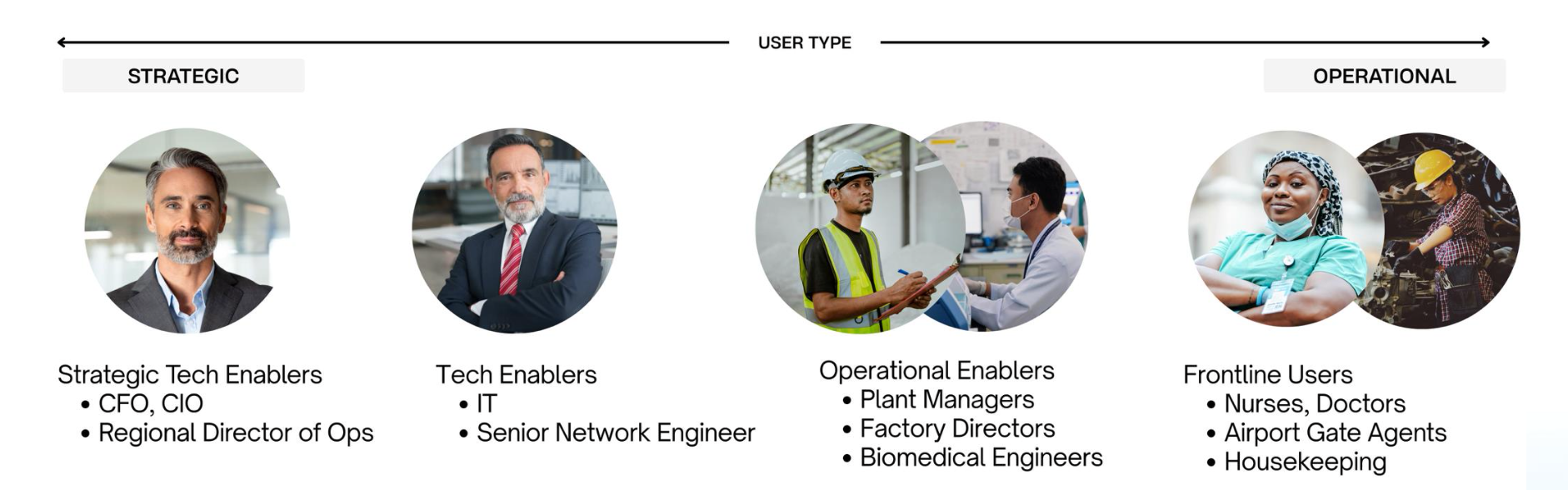
I interviewed and synthesized insights across a spectrum of user types.
INSIGHTS & PRIORITIZATION
Real-world voices informed our prioritization logic
Across industries, several consistent patterns emerged, and I developed a prioritization framework to identify where asset tracking delivered immediate, defensible value. I bucketed findings into 2 categories:
What Drives ROI in Asset Tracking
Key Requirements for Adoption
This framework narrowed the initial focus to regulated, asset-dense environments where tracking reduced downtime, loss, and compliance risk — particularly healthcare and advanced manufacturing. I presented these findings to the Chief Technology Officer and Director of Product at Cisco Spaces.
GO-TO-MARKET: PRICING & PACKAGING
Leveraging data to develop the pricing and packaging strategy
Enterprise software often involves software licenses, long deployments, and separate hardware that complicates pricing. I grounded my pricing recommendations in three inputs:
Density modeling across environments
I used access points (APs) to estimate number of assets tracked across healthcare, manufacturing, retail, and workspaces.
Real-world deployment behavior
I pulled real-world deployment data from Cisco to inform true usage, and used a bottoms-up approach to understanding the appropriate price range for its licenses.
Competitive benchmarking
With points 1 and 2 modeled, I compared our estimates against market offerings, including the technology, hardware, subscription, and deployment model.
GO-TO-MARKET: MESSAGING
Building an ROI case for Asset Tracking Solutions
Buyers need a clear, defensible ROI story that justifies budget, aligns with operational priorities, and resonates across technical and non-technical stakeholders. Two stories emerged as especially effective: Healthcare ROI and Manufacturing throughput and downtime reduction.

Healthcare: Quantifying ROI for Budget Holders
To support buyer conversations, I helped develop an ROI calculator that translated everyday operation friction due to lost assets into concrete financial impact. The calculator gave CIOs a one-year payback narrative that aligned with hospital budgeting cycles.
Manufacturing: Operational Bottlenecks to Revenue Impact
I shaped a case study with one of Cisco’s manufacturing customers, showing how lost assets leads to increased downtime, lower throughput, and inventory inaccuracy, directly translating to lost revenue.

Quantifying our messaging helped align product, sales, and customer conversations around a common value narrative, reducing friction in both adoption and expansion discussions.
OUTCOMES & IMPACT
Raising the bar on end-to-end product discovery and direction
Conducted 30+ customer discovery interviews with Cisco customers, partners, and users across healthcare and logistics to inform requirements for movement tracking and real-time alerts; used door-to-door tactics to gather insights shaping use cases
Aggregated and analyzed internal access point telemetry data to model market size and usage density, and operational constraints, directly informing product packaging and go-to-market strategy.
Conducted competitive analysis of 15+ location-tracking solutions; synthesized differentiators, deployment models, and price points into sales enablement materials.
Developed end-to-end product fluency, spanning market analysis, user research, prioritization, product definition, pricing, messaging, and GTM considerations.